




Headless Drupal: Balancing performance and multi-channel content delivery
One client came to us after being advised to adopt a headless architecture simply because “the website needs to be faster.” When they reviewed the estimate, however, they were surprised. A headless architecture effectively means managing two separate systems, resulting in development and operational costs that can be nearly double those of a traditional Drupal implementation.
Let us start with the conclusion. Some organizations are highly satisfied with a headless architecture, while others ultimately regret the decision. In most cases, the deciding factor comes down to “how many channels need to consume the same content.”
In this article, we explore common headless Drupal architecture patterns and examine situations where a headless approach may not be the right choice.
What does headless Drupal change?
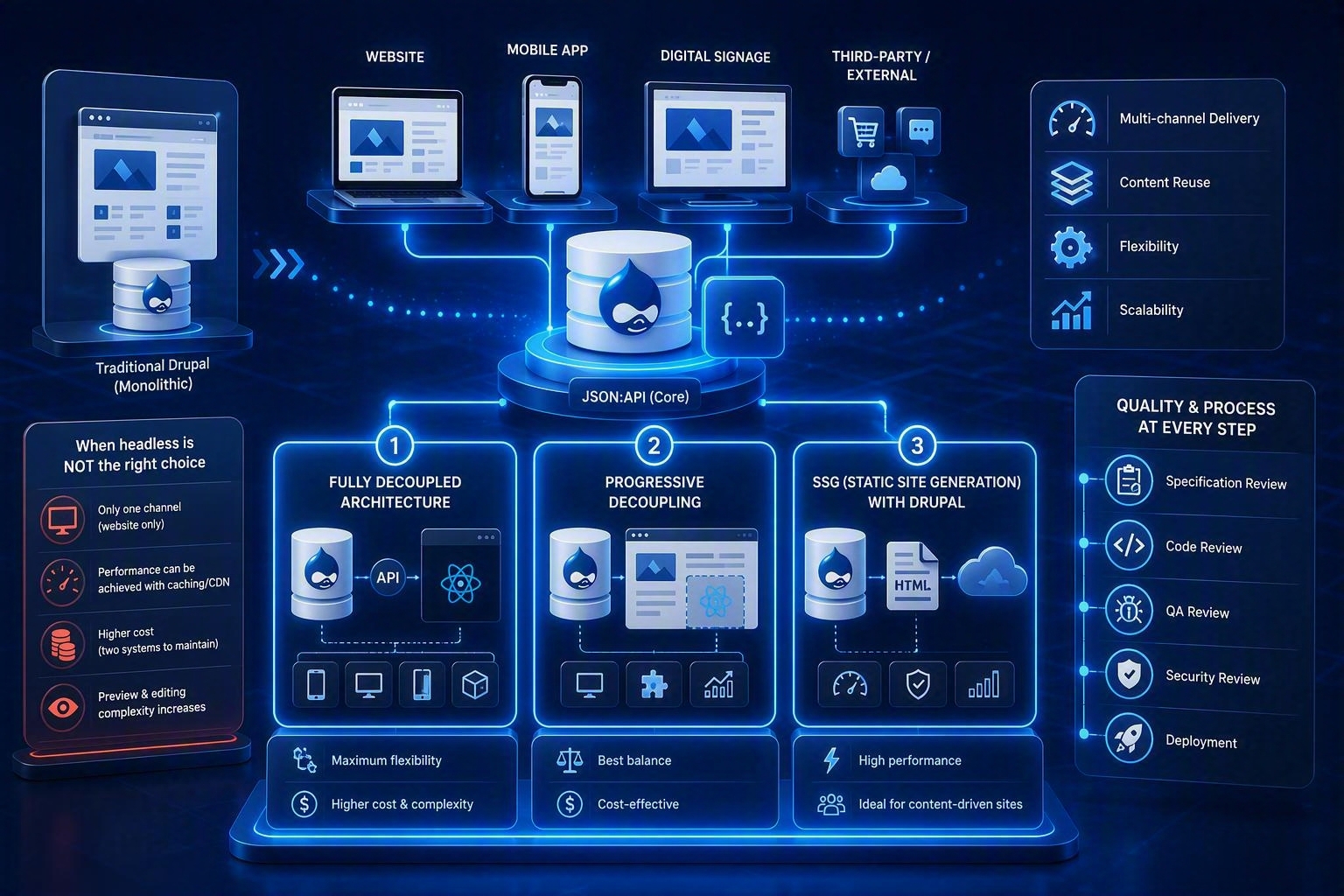
In a traditional CMS architecture, content management and page rendering are handled within a single system. A headless architecture separates these responsibilities. Drupal manages and delivers content through JSON APIs, while the presentation layer is handled by frontend frameworks such as React or Next.js.
One of Drupal’s key advantages is that JSON:API is included as a core feature. This allows organizations to begin API-based content delivery without additional modules. At the same time, Drupal can continue to operate as a traditional monolithic CMS, making headless adoption a flexible choice rather than an all-or-nothing decision.
The benefits are clear. A single piece of content can be delivered simultaneously across multiple channels, including websites, mobile applications, digital signage, and external platforms. The trade-off is equally clear. Because a headless architecture introduces a separate frontend layer, development and operational costs increase as the system effectively becomes two platforms instead of one.
Three common architecture patterns
①Fully decoupled architecture
Drupal is responsible only for content management and API delivery, while the frontend is entirely handled by frameworks such as Next.js.
This approach works best when content is already being distributed to channels beyond the website itself, such as mobile applications, digital signage, or external platforms. The trade-off is that features such as preview functionality, URL aliases, meta tags, and multilingual switching must be rebuilt on the frontend side.
②Progressive decoupling
Drupal continues to render most pages, while only highly interactive areas such as product search, dashboards, or dynamic components are implemented with React. In practice, this is often the most cost-effective approach. It preserves the content editor experience, including preview capabilities, while keeping development and operational costs under control. Despite these advantages, it is frequently overlooked during the evaluation phase.
③Static site generation (SSG) with Drupal
Drupal serves solely as the content management backend, while static HTML is generated and delivered through a CDN. This model is well suited to websites with low to moderate update frequency and high traffic volumes, such as campaign sites, investor relations portals, and press release platforms. It is also a strong option for organizations with strict security requirements that prefer not to expose a CMS on public-facing servers.
Risks to consider
The most common mistakes in headless Drupal projects are not technical. They stem from poor decision-making.
If the website is the only delivery channel, a headless architecture often provides little business value. When performance is the primary goal, optimizing caching strategies and CDN configuration is usually a more cost-effective solution.
“Preview functionality” is the most frequently overlooked requirement. Once the frontend is separated from Drupal, content editors may find themselves in a situation where “they cannot see the final result until the content is published.” This can lead directly to operational errors and content publishing issues. Features such as Next.js Preview Mode should be considered essential rather than optional.
Maintenance becomes more complex because there are now two systems to support. When frontend and backend responsibilities are handled by different vendors, troubleshooting and root-cause analysis can take longer and become more expensive.
Adopting technology simply because “it is new” can create long-term maintenance challenges. A modern architecture that lacks a clear business justification may result in a platform that is difficult to support a few years later. Technology decisions should always be driven by business requirements and operational needs, not by trends alone.
Market trends in Japan
Headless CMS adoption is increasing among organizations that need to deliver content across multiple channels.
The need to**”create content once and distribute it across websites, mobile applications, and in-store devices”** is becoming increasingly common among Japanese companies as digital transformation initiatives continue to expand.
At the same time, headless projects driven solely by**”the need for better performance”** often struggle to deliver a sufficient return on investment. In many cases, the additional complexity and operational costs outweigh the expected benefits.
Sources: themeisle CMS Market Share 2025
TTV’s actual Drupal experience
To date, we have delivered and maintained more than 10 Drupal websites across industries such as eCommerce, corporate websites, healthcare, and hospitality management systems, with expertise extending to the latest Drupal 11 platform.
Our Drupal specialists have also contributed 20 Contrib modules to the Drupal community based on real-world project requirements (drupal.org/u/zipme_hkt).
One module that is particularly relevant to headless architecture is Node Preview Context. This module resolves issues where node context conditions are not evaluated correctly in preview mode, directly addressing the challenge discussed in this article: “preview functionality breaking after frontend and backend separation.” It was developed as a practical solution to a real-world problem encountered during project delivery. Rather than simply claiming “headless Drupal expertise,” we have publicly available contributions that demonstrate how we have addressed these challenges in practice.
[To be confirmed: Headless CMS project experience, including industry, project scale, frontend technologies used (Next.js, Nuxt, React SPA, etc.), and which of the three architecture patterns were adopted. This information has been specifically requested by the client and should be verified with the Drupal team.]
[To be confirmed: Add a concrete example of how preview functionality was implemented (e.g., Next.js Preview Mode). Even a single real-world example would significantly strengthen the case study.]
Summary
The key theme of this article is “it’s not all or nothing.”
· Headless Drupal is not an all-or-nothing decision. In many cases, progressive decoupling offers the most practical balance between flexibility, cost, and maintainability.
· Because JSON:API is included in Drupal core, organizations can combine traditional and headless approaches, and gradually move toward a headless architecture when the need arises.
· If the website is the only content delivery channel, the business value of a headless architecture is often limited, making it difficult to justify the additional cost.
· The most commonly overlooked requirement is “preview functionality.” This should be addressed early in the requirements definition phase to avoid operational issues for content editors.
· We provide consulting services to help organizations evaluate whether a headless architecture is the right choice and compare different architecture patterns. If our assessment concludes that “a headless architecture is not the right solution,” we will say so honestly.
If you are considering a headless Drupal architecture, please feel free to contact us for a consultation.
Sources
· Drupal JSON:API(Core Module Documentation)
· JSON:API Include
· 2025 CMS Market Share(themeisle)
· Drupal.org Contributor Profile