




Drupal offshore development: How Vietnamese teams ensure quality through process
One client approached us after a disappointing offshore development experience. Their concern was straightforward: “We provided the specifications, but the delivered solution was not what we expected.” However, when we analyzed the root cause, it became clear that the problem was not the engineers’ technical capability. The real issue was the absence of a process for identifying and resolving specification ambiguities before development began. In offshore development, failures are often caused not by people, but by process. That is precisely why they can be prevented.
In this article, we take an in-depth look at the team structure, workflow, and quality assurance processes used by our Drupal team, sharing the same practices we use in real projects today.
What determines success or failure in Drupal offshore development?
To understand what makes Drupal offshore development successful, it is important to first understand why projects fail. In most cases, the root causes fall into four categories:
No process for identifying specification gaps or ambiguities → Developers make assumptions, resulting in rework that can take weeks.
No defined escalation path for questions → Issues remain unresolved during development and lead to major revisions after delivery.
Testing criteria depend on individual judgment → Test cases pass, but production issues still occur.
Architecture and code review standards depend on specific individuals → Quality declines when team members change.
None of these problems can be solved simply by hiring more talented engineers. They are process issues, and they require process-based solutions.
Drupal is actually well suited to distributed development. A large portion of Drupal functionality is built through configuration rather than custom code, and those configurations can be version-controlled and synchronized across environments using Configuration Management. This makes it much less likely to encounter situations where “it works in one environment but not in another.”
Four processes that ensure quality
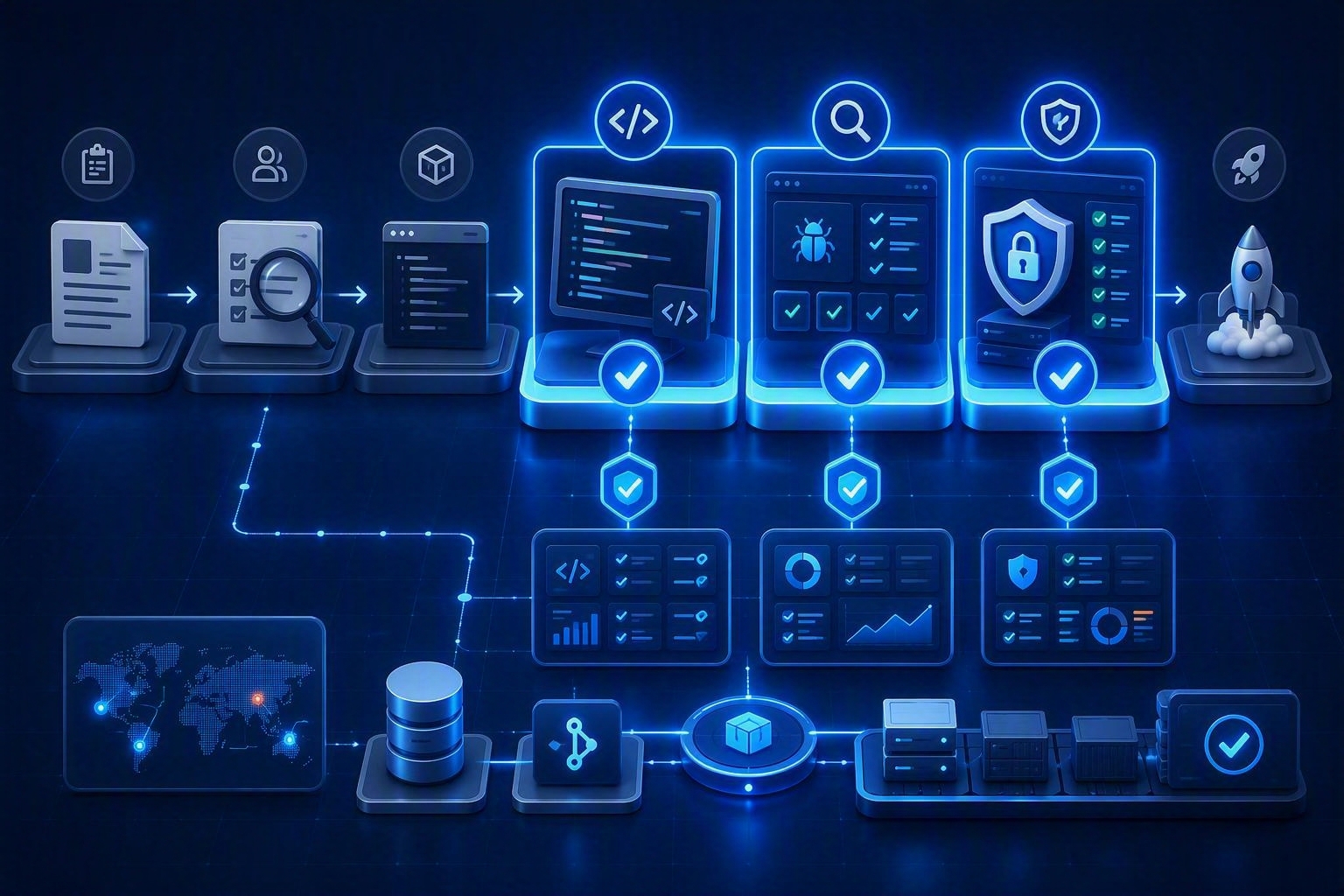
①Standardized design documentation and test criteria – We have established standardized templates and testing checklists across the organization. This ensures consistency in deliverables regardless of the individual assigned to the project and helps prevent dependency on specific team members.
②Independent reviews by a dedicated quality assurance team
A quality assurance team, separated from the development team, independently reviews defect analysis and quality checks. This avoids situations where developers are responsible for reviewing their own code.
③Drupal-specific quality checkpoints
In addition to standard web development reviews, our process includes Drupal-specific validations. These include verifying the absence of “core hacks” (direct modifications to Drupal core), ensuring proper extension through hooks and plugins, reviewing permission configurations, checking for missing cache tags, and confirming whether the modules in use are covered by Drupal’s Security Advisory (SA) program. The final point is especially important, as modules outside the SA program do not receive official security coverage when vulnerabilities are discovered. We always verify this before adoption.
④Eliminating environment differences through configuration version control – Using Drupal’s Configuration Management framework, configurations such as content types, fields, and views are exported as YAML files and managed in Git. This approach makes it possible to detect situations where “someone manually changed settings in production” and helps ensure that development environments in Japan and Vietnam remain fully synchronized.
[To be confirmed: Add information about the actual testing tools and security scanning tools currently in use, including the availability and coverage of automated testing. Please verify with the Drupal team.]
Risks to consider
There are a few points that should be considered carefully when evaluating an offshore development model.
· A small-time difference is a prerequisite, not a quality assurance mechanism. Japan and Vietnam are only two hours apart, but projects can still fail if the necessary processes and quality controls are not in place.
·When a vendor says, “we have automated testing,” it is important to understand what that actually means. Does the test coverage focus only on critical user journeys, or does it cover a broader range of functionality? The value of automation depends on its scope, not simply on the tools being used.
·Knowledge concentration is not unique to offshore development. The only effective way to mitigate it is through standardization. “Having a highly skilled engineer” can be a strength, but it also creates risk if key knowledge remains with a single individual.
· “Core hacks” often become a problem years later. The application may work perfectly at the time of delivery, but direct modifications to Drupal core can prevent future updates from being applied. For this reason, the use of “core hacks” should be explicitly prohibited and agreed upon before a project begins.
Market trends in Japan
Offshore development adoption continues to grow in Japan as organizations face ongoing shortages of development resources.
· Within quality assurance teams, the lack of automation remains a recurring challenge, while the shortage of experienced QA professionals continues to put pressure on software delivery and testing processes.
· Vietnam offers a practical advantage for offshore development due to its two-hour time difference with Japan. With business hours overlapping significantly, questions and answers can often be exchanged and resolved within the same working day, reducing communication delays compared to more distant offshore locations.
· Platforms such as Drupal further support distributed development by enabling configurations to be managed as code. Through Configuration Management, environment settings can be version-controlled and synchronized across teams, helping reduce the risk of environment inconsistencies in a structured and repeatable way.
TTV’s Drupal offshore development team structure
Our Drupal team is a dedicated organization supporting multiple projects in parallel for both the Japanese market and international clients.
Our experience spans a wide range of industries, including eCommerce, corporate websites, healthcare, and hospitality management systems. To date, we have delivered and maintained more than 10 Drupal websites, with expertise extending to the latest Drupal 11 platform.
■Role-based responsibilities
Each role has clearly defined responsibilities. This helps prevent knowledge silos and ensures consistent quality even when project responsibilities are transferred to another team member.
Role Responsibilities
PM Requirements analysis, project scheduling, and primary point of contact with the client.
BrSE Specification translation, communication bridging, and early identification of requirement ambiguities.
Drupal development Module selection, custom development, and architecture design that avoids “core hacks.”
QA Independent defect review and execution of Drupal-specific quality validation checkpoints.
R&D Technical reviews, validation of complex implementations, and development of in-house modules.
The R&D engineering team conducts technical reviews across all teams. This ensures that technical decisions remain consistent across projects, regardless of which team is involved.
This engineer has contributed 20 Drupal Contrib modules to the Drupal community based on real-world project requirements (Drupal Profile- [drupal.org/u/zipme_hkt](https://www.drupal.org/u/zipme_hkt)). Notable examples include Context Breadcrumb, which enables dynamic breadcrumb generation based on context, and Node Preview Context, which resolves node context issues on preview pages.
Because the team possesses expertise not only as users of Drupal modules but also as module creators, they can quickly determine whether existing modules are sufficient to meet requirements or whether customization and extension will be necessary, enabling better technical decisions early in the project lifecycle.
■Key points in our delivery process
Our role structure is designed to support the development process in the following ways:
• BrSE identifies specification ambiguities before development begins – Before implementation starts, areas that may be open to interpretation are reviewed and clarified with the client team. This helps prevent rework caused by assumption-based development.
• Independent QA verifies the absence of “core hacks” before production release – A dedicated QA team, operating independently from the development team, reviews the implementation to ensure that no modifications have been made that could interfere with future Drupal updates.
• Development is designed to avoid “core hacks” from the outset – Rather than relying on QA to detect and correct issues later, the development team follows an architecture-first approach that avoids direct Drupal core modifications during implementation.
■Results
· This delivery model has enabled us to release projects with minimal rework and establish long-term maintenance and support engagements with our clients. We believe that quality ensured through process creates value beyond a single project delivery and forms the foundation for long-term partnerships.
Summary
The key theme of this article is “ensuring quality through process, not individual talent.”
The root cause of most offshore development failures is not a lack of engineering capability, but the absence of a well-defined delivery process.
We ensure quality through four key mechanisms: standardization, independent QA, Drupal-specific quality checkpoints, and configuration version control.
Japan and Vietnam have only a two-hour time difference, enabling questions and answers to be exchanged and resolved within the same business day.
Drupal is particularly well suited to distributed development because configurations can be managed as code, reducing the risk of environment inconsistencies.
We provide consulting and development services for both Drupal offshore development and dedicated team (lab-based) development models. Whether you would like to review our team structure, development workflow, or sample design documentation, we are happy to share relevant information.
If you are interested in Drupal offshore development, please feel free to contact us for a consultation.
Sources
transcosmos technology Vietnam Services: https://trans-tech.vn/services/
Drupal Configuration Management: https://www.drupal.org/docs/configuration-management
Drupal.org Contributor Profile (zipme_hkt) : https://www.drupal.org/u/zipme_hkt
