




What Japan’s buzzword “Phone Farm” means for member sites and APIs
“Sumaho nōjō” (Phone Farm) was nominated for Japan’s 2026 Buzzword of the Year award[1]. The term refers to racks of smartphones operating together to artificially inflate likes and view counts on social media, and TV and newspapers reported on how these operations work throughout the year.
The coverage focuses on social media, but the same setup can be aimed at corporate web services such as sign-up, login and coupon campaigns. Because phone farms use real devices and real phone numbers, conventional bot defenses struggle to tell them apart from humans. Any company running a member site or a public API should take note.
Phone Farm in the news in 2026
According to media reports, notable cases include the following[2][3][4].
- TBS “Hodo Tokushu” (aired June 27, 2026): Demonstrated a post reading only “test” reaching one million views in six minutes
- NHK News (July 25, 2026): A teenager said to be involved with a phone farm testified that “social media numbers are easy to fabricate”
- Asahi Shimbun (April 2026): Reported that a domestic group generated 8,000 views per minute
- Europol takedown (October 2025): Dismantled a base in Latvia behind more than 49 million fake accounts, seizing about 40,000 SIM cards used for phishing and investment fraud
Some studies suggest the effect on public opinion is limited [2]. From the standpoint of web service abuse, however, the damage shows up as real costs, such as promotional budgets and SMS fees.
Expected damage to member sites and APIs
When phone farms target corporate services, the main entry points are sign-up and login. In many cases, attackers skip the screens entirely and call APIs directly to process requests in bulk.
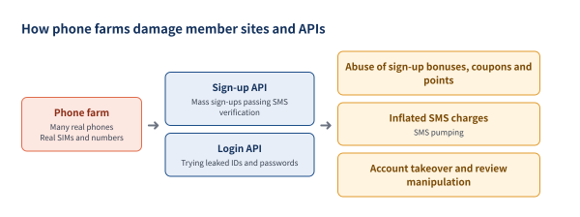
- Bonus and point abuse: Creating large numbers of accounts to collect sign-up bonuses and coupons
- SMS pumping: Triggering mass SMS verification messages to inflate sending charges
- Account takeover: Testing IDs and passwords leaked elsewhere, spread across many devices
- Rating and review manipulation: Posting large volumes of positive or negative reviews from fake accounts
What makes these attacks tricky is that each individual request looks like an ordinary user.
Why conventional defenses fall short: real devices, real numbers
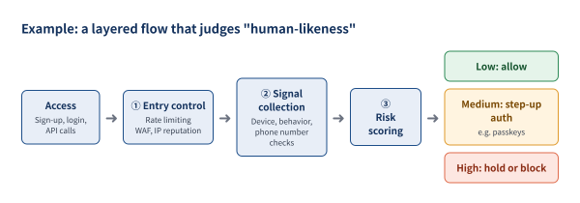
Conventional bots were mostly programs on servers accessing a site mechanically from specific IP addresses, so IP restrictions and CAPTCHAs could stop many of them. Phone farms, by contrast, use real handsets and mobile networks. Their device information and network paths look like those of ordinary users, and they pass SMS verification with genuine phone numbers.
Key points for your organization
Based on the OWASP API Security Top 10[5], here are the points worth checking on member sites and APIs.
- Rethink the assumption that SMS verification proves identity: Design on the premise that phone numbers can be obtained in bulk
- Control frequency and speed: Apply rate limits not only per IP but also per device, phone number and account
- Adapt authentication to risk: Require step-up authentication, such as passkeys, for suspicious access
Design business logic that removes the payoff: Grant bonuses only after identity checks, and cap sign-ups per device
A vulnerability assessment can confirm whether these measures work as implemented. From a phone farm perspective, the following items are especially relevant.
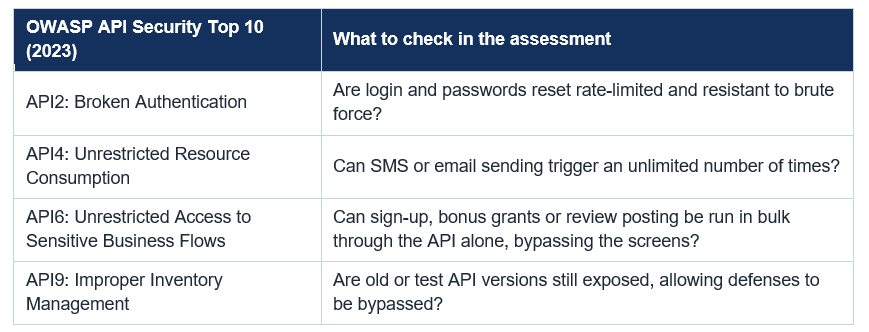
Many of these items are hard to find with automated tools alone. Review by engineers who understand the business flow is essential.
How TTV can help
“We want to check whether our member site and APIs can withstand attacks like phone farms.” If that sounds like you, we can help.
TTV operates SonarQube (static analysis) and OWASP ZAP (dynamic testing) in-house and combines AI-based triage with engineer review to deliver an end-to-end service, from assessment to proposed fixes. The Light and Standard plans require no repository access and can start with a trial, while the Full plan covers the source code as well.
Assessment plans (3 levels)
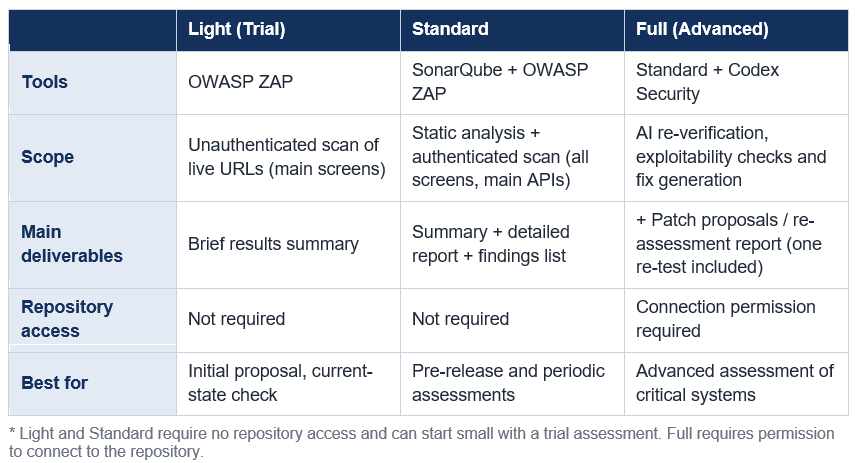
You can start with Light to understand the state of your live site and APIs, then move up to a higher plan as needed. We also offer debrief sessions for development teams and integration into CI/CD, and we support you until the fixes are complete. Please feel free to contact us.
Conclusion
“Phone farm” drew attention as a buzzword, but at its core it means large volumes of access that cannot be told apart from humans. Not just social media, but any web service that offers sign-up, login or bonuses can be a target.
Why not take this opportunity to review your member site and APIs?